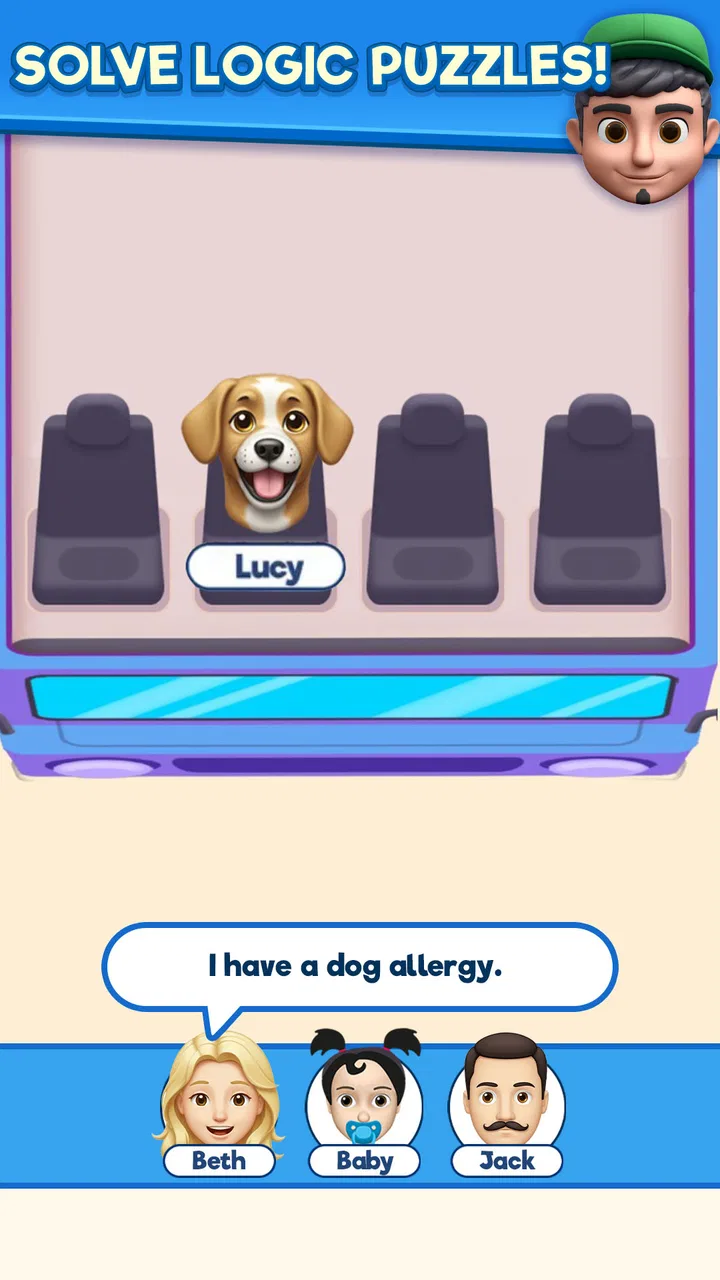
That's My Seat - Logic Puzzle
- 4.2
- Rating
- 10.00M
- Installs
- Free
- Price

 Analysis by App-foxy
Some puzzle games ask you to match colors or clear blocks, while That's My Seat gives you a more familiar problem: work out where each character belongs and arrange the seating correctly. That simple idea makes it easy to understand within seconds, but the decisions become less obvious as the logic gets tighter. I found it most enjoyable in short sessions, especially when I wanted something that required attention without demanding a large time commitment.
Developed by Rooftop Game, this free puzzle title focuses on reasoning rather than reflexes. Its store summary points to logic puzzles, IQ-style challenges, distinctive characters, and competition with friends, but the useful question is how it feels when a solution does not immediately appear. In my experience, the appeal comes from testing possibilities, noticing relationships, and correcting a mistaken assumption instead of relying on quick taps.
The game is available to an Everyone audience and runs on Android 8.0 or later. It has built a substantial audience, with more than ten million installs, a 4.5 average from roughly seventy-three thousand ratings, and around two thousand two hundred written reviews. Those figures suggest that the central seating concept has broad appeal, although popularity alone does not make every puzzle equally satisfying.
You May Also Like

 Blood Strike: 2.5 Anniversary
Blood Strike’s Loadouts Turn Every Drop Into a Tactical Gamble
A close look at Blood Strike’s custom loadouts: how fast access to signature weapons reshapes its battle royale rhythm, rewards preparation, and narrows the gap between fights.

 Pandora - Music & Podcasts
Pandora’s Music Is Easy to Start, but Harder to Recover
Pandora’s strength is its low-effort path from a seed to a station. Its weak spot is how much confidence it asks you to place in connection, setup, and quiet recovery.

 8 Ball Pool
 Is Built on Rivalries, Rematches, and Routine
A close look at the rivalries, rematches, shared routines, and unanswered safety questions that turn a quick pool match into a persistent mobile community.

 Samsung Music
’s Quiet Strength Is Playing What You Already Own
Its reach comes less from spectacle than from dependable access to a personal library. That simplicity is both the app’s strongest retention engine and its ceiling.

 AccuWeather: Weather Radar
AccuWeather Review: A Quick, Clear Forecast for Everyday Decisions
For everyday plans, the best forecast is the one you can understand quickly. AccuWeather makes rain timing, radar, and local conditions easy to act on, with a few trade-offs.

 Hill Climb Racing
Why Hill Climb Racing Still Turns Crashes Into One More Run
A tiny car, a bumpy hill and one more upgrade: Hill Climb Racing keeps resurfacing because its simple chaos makes every near-miss feel personal.
More From Our News Desk



Where the seating puzzles become difficult
The first few challenges are approachable because the objective is immediately readable: characters need to occupy the right seats, and the clues guide the arrangement. The real difficulty appears when several clues interact. A statement that seems useful on its own may only become meaningful after another placement has narrowed the possibilities. That is where I stopped treating each clue as a separate instruction and began building a small mental map of the whole row.
My most useful habit was to separate certainty from possibility. If a clue clearly fixes one character’s position, I treated that as an anchor. If another clue only suggested that two characters should be near or away from each other, I left it open rather than forcing an early answer. This prevents a common mistake in logic puzzle games: making one attractive guess and then bending every later clue to support it.
Players can also get stuck because the visual presentation makes the task feel simpler than it is. Characters may look distinctive, but recognition is not the same as a logical relationship. I learned to focus on the wording and the seat positions first, using the character appearance only to identify who was involved. That small change made wrong turns easier to spot.
A practical approach is to scan the puzzle twice. On the first pass, look for direct placements or exclusions. On the second, combine those findings with relative clues. This is more reliable than repeatedly tapping the same seat and hoping the answer reveals itself. It also makes the game feel less like trial and error and more like solving a compact deduction problem.
Why a correct-looking guess can waste time
When I put a character into a seat because it “felt right,” I often created a problem several steps later. The better method is to ask what the placement proves. If it proves nothing beyond satisfying one clue, it is probably too early to commit. A strong placement should either lock a position, remove a meaningful alternative, or connect two clues that were previously separate.
This is one of the game’s better learning moments. It encourages careful reasoning without requiring formal puzzle notation. For harder boards, I found it helpful to remember only the fixed positions and the most restrictive relationships. Trying to hold every possibility in my head made the experience slower, while tracking the decisive information kept the puzzle manageable.
That said, the game may feel less rewarding to people who want an immediate answer after every move. The seating format is intentionally based on deduction, so progress can pause while you reconsider the entire arrangement. I see that pause as part of the challenge, but players looking for constant action may find it frustrating.
Setup checks before blaming the puzzle
Because this is a mobile game, the first useful check is simple: confirm that the device is running Android 8.0 or newer. A compatible operating system does not guarantee a perfect experience on every phone, but it removes one obvious source of trouble. I would also install the current release, which is version 2.0.8, before spending time diagnosing behavior that may already have been corrected in a newer build.
Starting with a stable connection is sensible when installing or updating the game. If the download pauses, the installation fails, or the game does not finish loading, I would first switch between a dependable Wi-Fi connection and mobile data, then retry. Restarting the device is basic advice, but it can clear a temporary installation or loading problem without changing anything inside the game.
Storage space is another practical check. A phone that is nearly full can behave unpredictably during installation or updates, even when the app itself appears small. Removing a few unused downloads and trying again is safer than repeatedly tapping the install button. I would also close demanding apps in the background if the game opens slowly or responds late.
The game is free to download, but it includes optional in-app purchases ranging from ninety-nine cents to ninety-nine dollars and ninety-nine cents per item. That matters during setup because a player should know the difference between installing the game and choosing any optional purchase. I recommend checking the purchase confirmation on the device before handing the phone to a child, even though the content rating is Everyone.
For a first session, I would avoid changing several things at once. Install the game, open it, complete a few puzzles, and observe whether the issue happens consistently. If you immediately clear storage, reinstall, change networks, and alter device settings, it becomes difficult to know which action helped. A calm, one-step-at-a-time check is more useful.
Recovering a stalled or confusing session
If a puzzle seems impossible, I would not assume the game is broken immediately. First, reread every clue from the beginning and check whether I accidentally treated a possibility as a requirement. Seating puzzles are particularly vulnerable to this error because one wrong assumption can make every remaining arrangement appear invalid.
Next, I would rebuild the arrangement from the strongest clue rather than continuing from the current layout. Remove the placements that were based on guesses, keep only the positions that are logically secure, and test the remaining options again. This “reset the reasoning” workflow is often faster than staring at a nearly completed but inconsistent row.
If the interface stops responding, I would leave the puzzle and reopen it after closing the game normally. A device restart is the next reasonable step if the problem continues. Reinstalling should be a later option, because any locally retained progress may not return automatically after removal. I would only take that step after deciding that losing local session information is acceptable.
When a puzzle feels visually unclear, increasing the phone’s general text or display size may help, but it can also alter how much of the game fits on screen. I would try the device’s standard display settings carefully and return them to normal if the layout becomes less comfortable. The goal is to improve readability without introducing a new presentation problem.
Another useful recovery technique is to take a short break. That sounds unimportant, but logic errors often come from repeatedly applying the same interpretation. After a few minutes away, I was more likely to notice that I had reversed a relationship or overlooked a restriction. The game works better when I approach it with a fresh set of eyes than when I rush through frustration.
When the app is not the cause
Not every failed load or delayed response comes from That's My Seat. An unstable connection, an almost-full phone, an outdated operating system, or aggressive background memory management can all create symptoms that look like an app fault. Comparing the behavior after a device restart and on a different connection is a useful way to separate a local problem from a game-specific one.
There is also a difference between a puzzle being unfair and a puzzle exposing a weak assumption. If every clue is readable but the answer conflicts with your first idea, that usually means the reasoning needs to be rebuilt. If text or controls are genuinely missing, frozen, or displayed incorrectly across repeated attempts, then the issue is more likely technical. Keeping those situations separate helps avoid unnecessary reinstallations.
Purchase-related concerns deserve the same care. A player who sees a payment prompt should not assume that the game requires payment to start. Since the title is free with optional purchases, I would cancel any prompt that is not wanted and review the device’s purchase controls. This is especially important on shared devices, where a child may tap through a confirmation screen without understanding its meaning.
For performance problems, I would compare a short session immediately after restarting the phone with a session after many other apps have been open. If the game behaves normally in the first situation, the phone’s available resources or background activity may be contributing. If the same fault appears every time in the same puzzle, recording the exact step where it happens is more useful than simply reporting that “the game does not work.”
This troubleshooting mindset also protects progress. Before clearing app storage or reinstalling, I would consider whether the current puzzle state matters and whether the device offers any way to preserve it. A clean reinstall can solve corrupted local files, but it is not a harmless first step. For a puzzle game built around gradual progress, recovery should come before removal.
How it fits into everyday play
I can easily imagine using the game during a short break, on public transport, or while waiting for an appointment. The seating concept is easier to return to than a story-heavy game because the objective is self-contained. I could solve one puzzle, put the phone away, and come back later without needing to remember a plot or a complicated control scheme.
It also suits someone who enjoys paper-based deduction but wants a cleaner mobile format. Instead of drawing rows and crossing out possibilities manually, the player works directly with the characters and seats. The trade-off is that a paper grid gives complete freedom to annotate every possibility, while a phone puzzle can make complex reasoning feel more confined. Players who love writing detailed notes may still prefer a traditional puzzle book or a dedicated brain-training alternative.
Compared with match-three games, this is slower and more deliberate. There is less emphasis on speed, visual effects, or building a chain of quick moves. Compared with crossword or word puzzles, it relies less on vocabulary and more on relationships between positions. That makes it a good choice for someone who wants a language-light reasoning challenge, but not ideal for a player who prefers creative answers or broad general knowledge.
The friend-competition angle can add motivation if you enjoy comparing solutions, but I would not choose the game solely for social play. The strongest part of the experience is the individual deduction. If your priority is real-time multiplayer, constant interaction, or a large competitive system, another category of game will probably serve you better. Here, competition is more naturally a way to compare how quickly or cleanly people reason through the same type of problem.
One non-obvious benefit is that the game rewards disciplined thinking rather than fast tapping. I found myself becoming more careful about the difference between “must be here” and “could be here,” a distinction that also helps with scheduling, planning, and other everyday decisions. It is not a formal learning tool, but the puzzle structure gives casual practice in eliminating options.
Who should install it, and who should skip it
I would recommend it to players who like compact logic challenges, enjoy testing assumptions, and do not mind pausing when a solution requires a full rethink. It is also a reasonable pick for families looking for an Everyone-rated puzzle game, provided an adult manages optional purchases on a shared device.
I would be more cautious about recommending it to someone who wants a relaxing game with no wrong answers. Seating puzzles can become mentally demanding precisely because a small mistake affects the entire arrangement. It is also not the best match for players who expect deep narrative, action controls, or a large variety of puzzle formats. The focused concept is a strength when it matches your taste, but a limitation when you want constant novelty.
My practical tip for new players is to solve with a two-column mindset: keep “certain” placements separate from “possible” ones. My second tip is to restart the reasoning, not necessarily the app, when the arrangement becomes contradictory. My third is to treat a purchase prompt as optional and verify it before confirming. Together, these habits address the most common sources of wasted time: premature guesses, unnecessary troubleshooting, and accidental spending.
Rooftop Game has kept the entry point simple, and the current version gives the title a clear identity as a focused mobile puzzle rather than an overloaded collection of modes. The free access makes it easy to test whether the seating format suits you. At the same time, the optional purchase range means I would pay attention to device controls and avoid assuming that every useful-looking prompt is necessary for solving.
After spending time with it, I see That's My Seat as a good recommendation for short, thoughtful sessions. Its best moments come when several ordinary clues combine into one satisfying conclusion, and its main weakness is that the same structure can feel repetitive or frustrating if you want faster rewards. With Android 8.0 or later, a little patience, and a willingness to separate facts from guesses, it offers a clear and approachable way to exercise your reasoning.
My final verdict is positive, but specific: install it if arranging characters through deduction sounds more appealing than matching tiles, answering trivia, or chasing reflex-based scores. Skip it if you need constant action or a broad range of puzzle styles. For the right player, the simple premise is enough to create a useful daily brain break, and the moments when a tangled seating plan finally makes sense are genuinely satisfying.
FAQs for That's My Seat - Logic Puzzle
01What is the main objective of That's My Seat - Logic Puzzle?
That's My Seat - Logic Puzzle challenges players to strategically allocate seats to various characters based on specific rules and constraints. The objective is to solve each puzzle by ensuring all conditions are met, such as seating certain characters next to each other or keeping others apart. It's a test of logic and spatial reasoning.
02Is That's My Seat - Logic Puzzle suitable for all ages?
Yes, the game is designed to be family-friendly and suitable for players of all ages. The puzzles range from simple to complex, allowing both children and adults to enjoy and challenge themselves. The intuitive interface and engaging gameplay make it accessible for younger players, while the more difficult levels provide a challenge for adults.
03Does That's My Seat - Logic Puzzle require an internet connection?
No, That's My Seat - Logic Puzzle can be played offline. Once downloaded, you can enjoy the game anytime and anywhere without needing an internet connection. This makes it a great option for travel or when you're in areas with limited connectivity.
04Are there in-app purchases in That's My Seat - Logic Puzzle?
Yes, the game offers in-app purchases. While the core gameplay is free, players have the option to buy additional hints, level packs, or to remove ads for an enhanced experience. However, all levels can be completed without purchases, ensuring a fair experience for all players.
05How often are new levels added to That's My Seat - Logic Puzzle?
The developers regularly update the game with new levels and challenges. This keeps the experience fresh and engaging for players who have completed existing puzzles. Updates often include new themes and features, so be sure to keep the app updated to enjoy the latest content.
Pros
- Challenging puzzles to enhance problem-solving skills.
- Visually appealing graphics with smooth animations.
- Intuitive controls make gameplay easy to navigate.
- Regular updates with new levels and challenges.
- Offline mode available for uninterrupted play.
Cons
- Limited hints can make some levels frustrating.
- In-app purchases can be a bit pricey.
- Ads may interrupt gameplay frequently.
- Occasional glitches on older devices.
- No multiplayer option for competitive play.

That's My Seat - Logic Puzzle
Gallery